

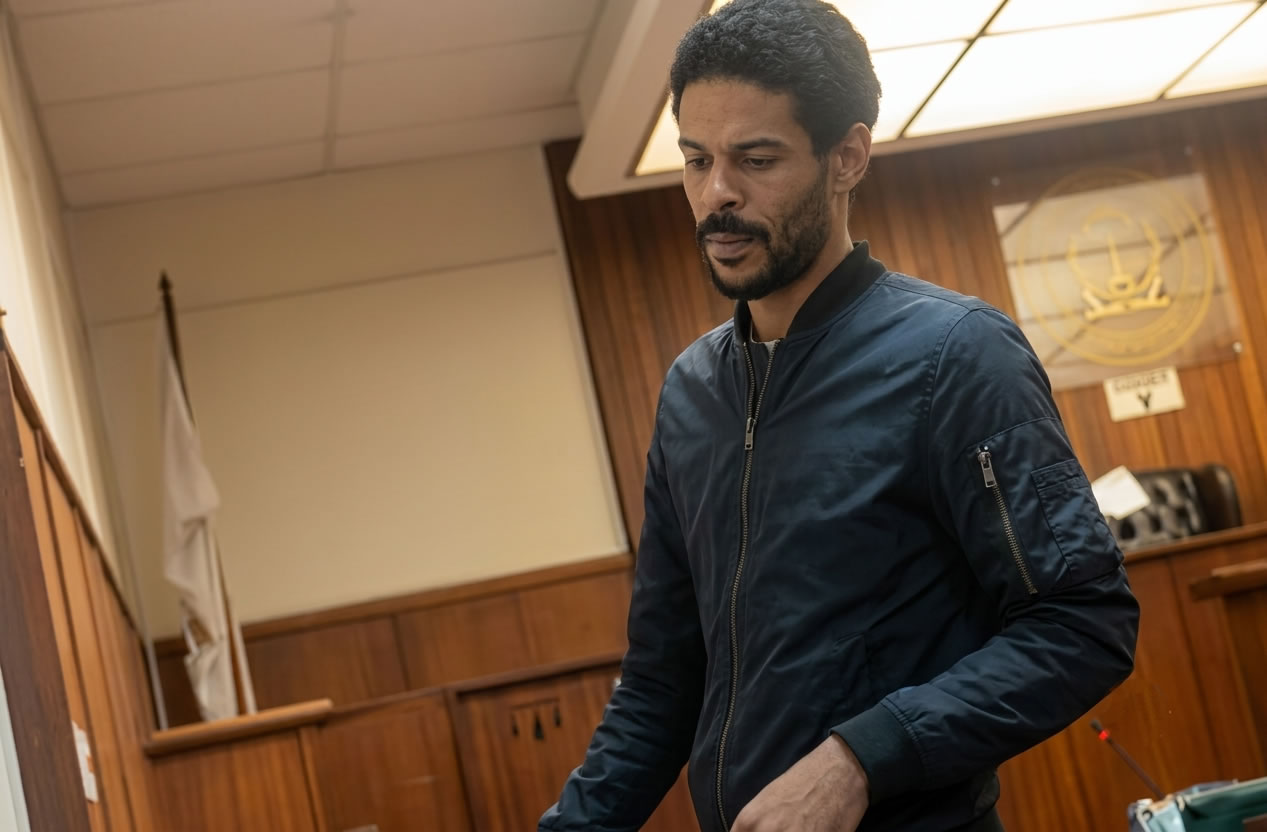
Pinetown – In a case that has gripped the nation, Thabo Ntokozo Nzimande, 33, has been found guilty of the brutal murder and decapitation of his 80-year-old grandmother, Beatrice DeLange. The Durban High Court delivered its verdict on Thursday, 16 July 2026, dismissing Nzimande's defence of a drug-induced blackout as "selective amnesia". The horrific details of the crime, which occurred on 7 June 2024, included Nzimande emerging from his grandmother's bedroom, swinging her severed head, and kicking it across the floor, all while claiming ancestral instructions.
The chilling events of that fateful night unfolded in the granny flat Nzimande shared with his grandmother in Pinetown. John Ngcobo, Nzimande's uncle and DeLange's son-in-law, provided harrowing testimony that became a cornerstone of the State's case. Ngcobo recounted how he and his wife, Delisile, were in the main house on the same property when they heard disturbing noises emanating from the granny flat. Upon investigation, their repeated knocks on the door went unanswered for approximately 15 minutes.
As Delisile returned to the main house, a concerned Ngcobo persisted, attempting to get Nzimande's attention. It was then, through a sliding door, that he witnessed a scene of unimaginable horror. Nzimande, covered in blood, emerged from DeLange's bedroom, holding her severed head. Ngcobo testified that Nzimande moved the curtain aside, holding the deceased's head and swinging it from side to side. The accused then dropped the head and kicked it against the floor, allegedly stating that he "had to do it" and that his ancestors had instructed him to commit the act. He then chillingly told Ngcobo to call the police to arrest him because he had killed DeLange.
Police officers who responded to the scene corroborated Ngcobo's account, further solidifying the timeline of events. They testified that Nzimande threw the keys to the flat out of a window to them, indicating no third party had entered or exited the premises. Upon gaining entry, officers found DeLange's severed head in the lounge, while her headless body lay in another room. Nzimande himself was found with blood on him. His cousin, Zwelethu Ngcobo, also testified that Nzimande, while in the back of a police van after his arrest, shouted that "the whole of Pinetown was going to know who he was".
Throughout the trial, Nzimande's defence hinged on a claim of temporary insanity, asserting he had no memory of the murder. He testified that on the night of the incident, he had consumed at least eight prescribed pills, including antidepressants and sleeping pills, and had smoked dagga before passing out. He claimed to only recall waking up to the noise of police and "flashing blue lights". However, Acting Judge Mpumelelo Sibisi vehemently rejected this defence, stating, "There's no corroboration of the accused's version or defence; there is no proper foundation to reach the conclusion that dagga and the medication he took led to involuntary actions". The judge concluded that Nzimande's denial was a lie, pointing out his "selective amnesia" when confronted with crucial questions.
A psychiatric assessment conducted at Fort Napier, a state psychiatric hospital, found Nzimande fit to stand trial. Dr. Shaun Hain, who conducted the assessment, testified that Nzimande was of sound mind at the time of the evaluation, though he could not definitively speak to his state of mind at the exact moment of the murder. When questioned about Nzimande's behaviour of kicking DeLange's head, Dr. Hain described it as irrational, further undermining the defence's claims of involuntary action. The court found that Nzimande had committed the crime voluntarily, evidenced by his interactions with his uncle and the police.
The tragic victim, Beatrice DeLange, was an 80-year-old woman who had been a pillar of support for her grandson. The State's case revealed that Nzimande's maternal family had struggled with his long-standing drug addiction, leaving DeLange as the only relative willing to accommodate him. Her condition for his stay was strict: Nzimande had to attend rehabilitation and undergo frequent drug tests. In the days leading up to her murder, Nzimande had taken a drug test whose results were inconclusive, reportedly leaving DeLange disappointed. This detail paints a poignant picture of a grandmother desperately trying to help her grandson, only to become his victim.
This horrific incident, while shocking in its brutality, unfortunately, echoes a disturbing trend of violence against the elderly in KwaZulu-Natal and South Africa at large. Reports indicate that elder abuse is a significant concern, with a high percentage of cases involving family members as perpetrators. While specific recent statistics for KZN are difficult to pinpoint, broader South African data and news reports highlight the vulnerability of older persons to various forms of abuse, including physical violence and murder, often at the hands of those closest to them. The KwaMashu beheading of Slindile Mkhize in October 2025, where a woman was found decapitated in her burning home and her cousin arrested after her head was found nearby, serves as another grim reminder of the extreme violence that can occur within families in the region.
The defence's attempt to attribute Nzimande's actions to "ancestral instructions" also touches upon a complex cultural and legal intersection in South Africa. While traditional beliefs hold significant sway for many, the legal system generally does not recognise such claims as a valid defence for criminal acts, particularly when mental capacity is proven. The court's rejection of this claim in Nzimande's case underscores the judiciary's stance on accountability for violent crimes, regardless of purported spiritual motivations.
In mitigation of sentence, Nzimande testified on Friday, 17 July 2026, expressing a struggle to come to terms with his grandmother's death. "I still don't believe that she is gone. I can't come to terms with the fact that she is not here anymore and that I will never see her again," he stated.
He maintained his lack of recollection, saying, "I don't see myself being able to do something like what the court described as having happened that night. I don't remember a single thing".
However, he could not explain the presence of kitchen knives lodged in DeLange's body. When asked by the State advocate if he had expressed remorse to his maternal family, Nzimande replied that he could not admit to something he did not remember doing, though he claimed to have asked his cousin to convey his condolences. This perceived lack of direct remorse, coupled with his denial of memory, is likely to weigh heavily during sentencing. The case has been postponed to late September for sentencing proceedings, allowing for the preparation of a probation officer's report.